
BOP Release Status Outcomes
The Federal Bureau of Prisons holds people serving federal sentences. A BOP release can mark completion of imprisonment, but it does not always mark the end of federal court obligations. A person may begin a term of supervised release administered by U.S. Probation and Pretrial Services. Another authority may also take custody under a detainer, warrant, or separate case. The BOP result should therefore be read as a statement about BOP control, not a statement about residence or complete freedom from all legal restraint.
A McCurtain County jail exit can precede a federal episode when the local record shows a federal writ, hold, or transfer. In that sequence, the sheriff’s release field closes county custody, while the federal record describes what happened next. A true county community release and a delivery to a federal authority are not interchangeable. Confirm the receiving agency on the county release record before treating the BOP search as the correct path.
Search BOP Release Records
Use the official BOP Inmate Locator for someone sentenced to federal custody. The locator covers federal inmates from 1982 to the present. Search by a federal identifier when one is known because names can collide. Name searches can be narrowed with the age, race, and sex fields provided by the interface.
- Confirm that a federal sentence, judgment, or transfer makes BOP custody plausible.
- Search by BOP Register Number, DCDC number, FBI number, or INS number when available.
- Otherwise enter the legal name and use the age, race, or sex filters carefully.
- Compare the returned identity details before treating the result as the same person.
- Read the custody wording and release date exactly as displayed, then record the access date.
- Use the federal court docket to determine the sentence and any supervised-release term.
The locator is a historical starting point, not a complete release certificate. Its released date can confirm the end of BOP custody shown in that record. It does not identify a current home, establish whether supervision remains, or explain an immediate transfer to a state, local, tribal, or immigration authority.
Note: Search the BOP locator only when a federal source supports the custody path, not merely because a county name disappeared.
Official BOP Release Locator
The official federal locator provides both identifier and biographical search routes. The captured interface shows the national source used for sentenced federal custody and a non-custody or released result, without turning the result into a claim about where the person went next.
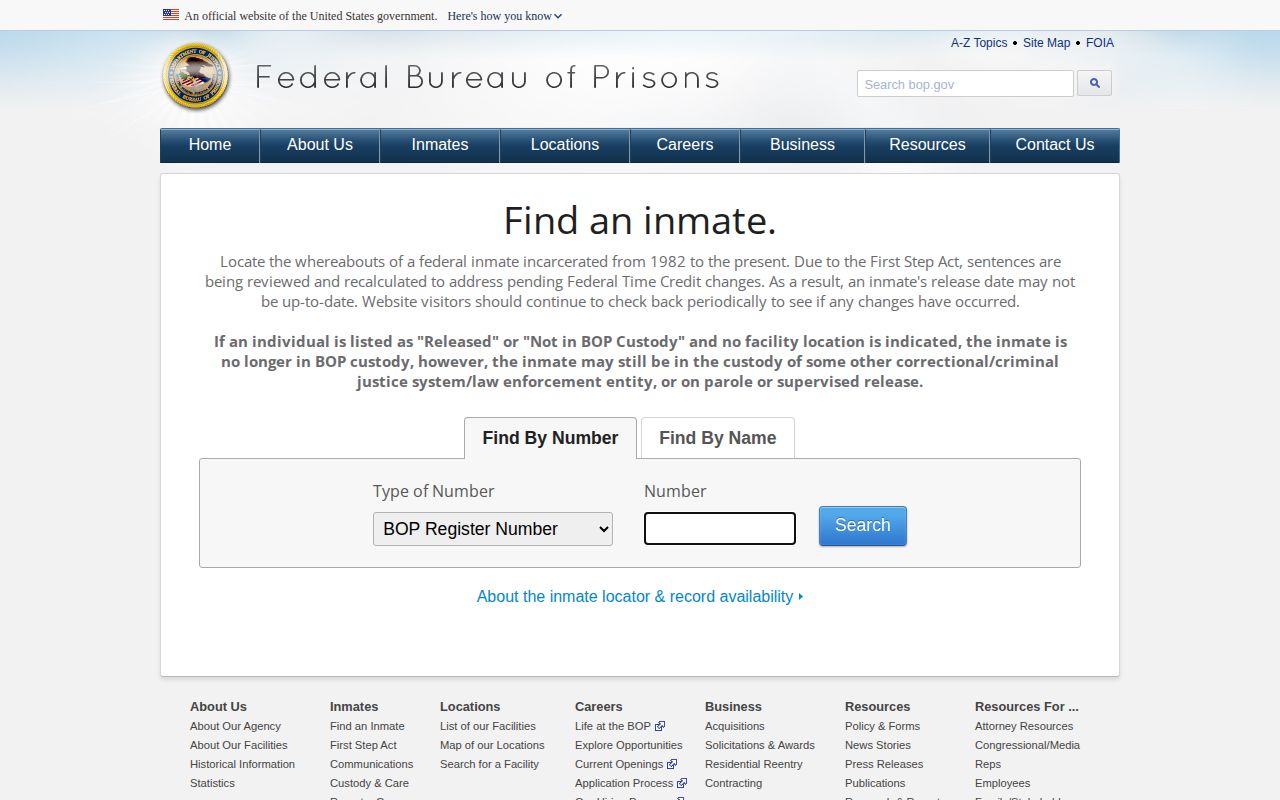
The search screen belongs to BOP, not the McCurtain County Sheriff or ODOC. County and state databases cannot replace it for a completed federal prison episode.
BOP Release Result Meaning
A useful result begins with identity. Federal register numbers are stronger than a name alone. Date and custody wording must be preserved as labeled because a search interface can change. The record should then be paired with the federal case so the sentence and post-prison terms are not guessed from a short locator line.
| Locator item | What it establishes |
|---|---|
| BOP Register Number | The federal correctional identifier for the record |
| Name and identity fields | A basis for distinguishing similar people |
| Custody wording | Whether BOP reports current control or a past episode |
| Release date | The date displayed for the end of that BOP custody episode |
| Access date | When the changing public result was reviewed |
A locator record does not explain the legal basis for every transition. The federal judgment and docket can identify imprisonment and supervised release. A county release record can show delivery to federal custody. A later receiving-agency record can establish a transfer that the BOP result does not name.
The 1982 coverage boundary is also important. The locator is the stated route for federal inmates from 1982 to the present, but it should not be represented as a full historical index of every older federal confinement. When the relevant episode predates that period, the federal court case and official federal records channels become more important than repeated name searches.
Federal Court Release Context
The federal criminal docket is the main legal context for a BOP sentence. It can show the judgment, sentence, amended orders, appeals, revocation proceedings, and supervised-release terms available in the public case. A judgment explains what the court ordered, while the BOP locator reports correctional custody. Neither record alone proves every physical handoff.
Use the case number from the federal record when possible. Defense counsel can explain a recent or ambiguous transition to an authorized party. U.S. Probation and Pretrial Services manages federal supervision after imprisonment, not BOP. That agency split mirrors the difference between a prison release and completion of all court-ordered supervision.
- Federal imprisonment
- Custody serving a sentence administered by BOP.
- Supervised release
- A court-ordered federal supervision term that can follow imprisonment.
- Detainer
- A notice that another authority may assume custody.
- Transfer
- A handoff between custodians without a community release.
BOP Release Contact Route
The research identified no federal prison or BOP walk-in release desk in McCurtain County. BOP is a nationwide system, and the facility depends on the person’s federal record. Use the locator and official BOP inmate information route to identify the relevant institution or current instructions. Do not substitute a county-branded directory.
Federal Bureau of Prisons
Nationwide sentenced-federal custody system
Facility varies by federal assignment
Public locator: bop.gov/inmateloc
No McCurtain County BOP release desk was documented
Federal supervision is handled separately by U.S. Probation and Pretrial Services.
When BOP reports a past episode, a facility may no longer be the right records contact. Follow current BOP records directions and identify the register number, federal case, and custody date range. If the question concerns supervision rather than prison custody, use the federal court or probation office connected with the case.
A focused inquiry should separate three dates: the McCurtain County transfer date, the federal prison custody dates, and any later release date shown by BOP. Those dates can belong to different agencies and phases. Include the federal register number and case number when known, and ask for the specific existing record needed rather than a broad explanation of the person’s history.
Note: A local county office cannot certify a later BOP release unless its own record concerns the original federal transfer.
Verify BOP Release Destinations
A BOP release result does not state where the person lives. It may not name a supervising office or a different authority that took custody. To determine the destination, read the federal docket for the judgment and supervised-release terms, then look for a detainer, transfer, or later case supported by an official record. Do not infer a destination from a date alone.
Federal supervised release is distinct from Oklahoma parole and probation. It is imposed by the federal court and administered by U.S. Probation and Pretrial Services. A person can therefore be outside BOP custody while still subject to federal supervision. Completion of BOP imprisonment and completion of federal supervision are separate events and may have different records.
If another sovereign assumed custody, request the receiving agency’s record for that later episode. BOP can establish the end of its own custody, while the state, county, tribal, or immigration authority establishes what followed. This source-by-source method avoids turning a valid BOP release date into a broader claim the locator does not support.
Federal Release System Boundaries
BOP, ICE, and the U.S. Marshals Service serve different roles. BOP is the public locator for sentenced federal prisoners. ICE manages civil immigration detention and has its own locator. USMS manages many federal pretrial and court detainees, often through contract holding facilities, but has no public name-based locator. A failed BOP search can therefore mean the person is outside BOP’s sentenced-custody data, not that no federal detention exists.
ODOC Offender Lookup is also separate. It covers Oklahoma corrections, not a federal sentence. OK VINE tracks reports from participating agencies and should not be assumed to duplicate the BOP locator. Select the system from a federal judgment, detainer, receiving-agency field, or other reliable custody indicator.
The McCurtain County released inmates search path begins with the source that created the local release or transfer record. If the sheriff recorded delivery to federal custody, preserve that county event and then follow the federal episode through the proper national source.